Turks and Caicos History
Turks and Caicos Islands History
The Turks and Caicos Islands has had a varied and truly fascinating past. The known history of the islands is of recent occurrence, comparatively speaking, with the first human habitation commonly accepted as occurring about 1000 years ago.
The Turks and Caicos Islands is a tropical archipelago of eight large islands and many small islands and cays, with a total of about 100 named islands, cays, and rocks. As our nation’s name suggests, the country consists of two island groups: the Turks Islands, and the Caicos Islands. The Turks Islands include Grand Turk and Salt Cay, and the more expansive Caicos Islands consist of Providenciales, West Caicos, North Caicos, Middle Caicos, East Caicos, South Caicos, and Ambergris Cay. Only eight of the islands in the Turks and Caicos are inhabited.
It’s thought that the first peoples to have permanently inhabited the islands that are now the Turks and Caicos were the Lucayans. These people were a subset of the Taino language peoples that migrated north through the Caribbean from South America, likely settling in our islands sometime around the years 700-1000 AD.
After the arrival of Christopher Columbus in 1492, the Lucayan peoples rapidly disappeared from the Turks and Caicos and the greater Bahamian Archipelago. This was primarily due to Spanish slavery for gold and silver mining in other regions in the Americas, and the pearl diving industry.
Into the 1500s and early 1600s, the Turks and Caicos was largely uninhabited, and only experienced the occasional visit by explorers, salt gatherers, and vessels driven off course by storms. Several famous European explorers, including Martin Alonso Pinzón, Juan Ponce De Leon, Sir Richard Grenville, and Captain John White made stops in the islands.
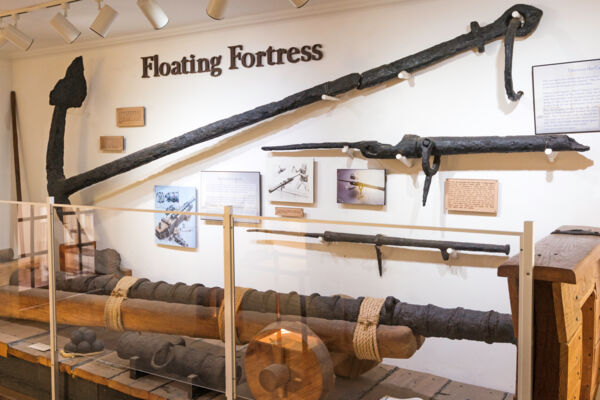
In the latter 1600s, the scourge of piracy became established in the Caribbean, Bahamian Archipelago, and eastern North America. Pirates and privateers began to frequent the Turks and Caicos, and especially the Caicos Islands, where there were sources of fresh water and countless places to hide and prey on passing vessels.
In the late 16th century and into the mid-17th century, Bermudians began to regularly visit Salt Cay and Grand Turk to rake salt, and the foundations for the organized sea salt industry were laid. For the following three and a half centuries, salt exports were the primary source of income for the islands.
Into the early 18th century, control of the Turks and Caicos was claimed by a few European powers, with control being contested by the Spanish, French, and British. Horatio Nelson suffered one of his few defeats attempting to retake Fire Hill on Grand Turk from the French. Control of Grand Turk was later returned, which was ratified by the 1783 Treaty of Versailles. The Turks and Caicos after which was a colony of Great Britain.
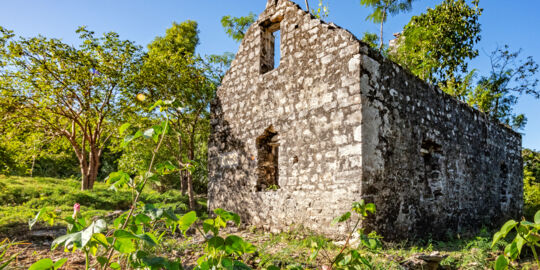
After the American War of Independence, displaced British Loyalists from the American Colonies migrated to the Turks and Caicos starting 1783, many of which went on to form cotton plantations. At the time. African slaves were brought in by the Loyalists to work in the cotton fields.
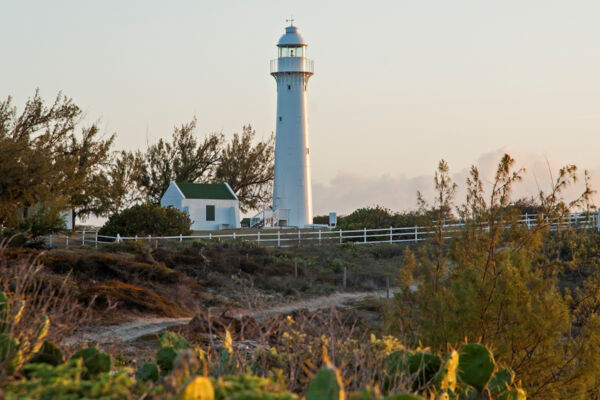
The 19th century saw quite a bit of economic change and social development in the Turks and Caicos. The cotton industry essentially failed due to disease and hurricane damage. The salt industry continued to bring wealth and some cultural and civic improvements to Grand Turk, Salt Cay, and South Caicos. The Caicos Islands saw the emergence of new industries including sisal planting, guano mining, and sponging. The capital city of Cockburn Town developed, churches, schools, and the Grand Turk Lighthouse were built.
Due to the financial failures of the local presidency at the time, the Turks and Caicos was annexed to the British colony of Jamaica.
In the mid-1800s, the Caicos Islands also had an influx of African peoples and heritage independent of the slaves brought by the Bermudian salt rakers and the Loyalists, when the Spanish slave ships Trouvadore and Esperanza wrecked at East Caicos, and some of the survivors were freed in the islands. Settlement names such as Bambarra and Nongatown on Middle Caicos may have been a reflection of this later African era of culture.
Into the later 20th century, the Turks and Caicos saw the decline and essential collapse of the salt industry and agriculture. This was mainly due to the poor international competitiveness of the local small scales of production. In the 1950s, the United States built Navy, Air Force, and Coast Guard bases in the islands, which brought some much-needed income to the economy. Change was occurring with governance as well. Due to the impending independence of Jamaica from the United Kingdom, the Turks and Caicos transitioned to a British Overseas Territory, with elements of self-rule.
In the mid-1980, the island of Providenciales and by extension the country as a whole began its transformation into a tourism destination. The start was the construction of the Third Turtle Inn, the Club Med Turkoise resort, and the Providenciales International Airport (PLS). World-famous Grace Bay Beach was finally accessible to international tourists, and word began to get out of the crystal clear water, exquisite reefs, and white sand beaches.
Timeline of Turks and Caicos History
-
500-700 AD
The first known inhabitants of what is now the Turks and Caicos arrive in the islands, likely via Hispaniola. These were a Taino language people, often referred to as the Island Arawak, Lucayan Taino, or simply the Lucayan people.
-
900
The larger known Lucayan settlement sites have been built, and somewhat consistent trade routes in the region have been established by the Lucayans. Salt, dried conch, and beads from the islands would have been exchanged for honey, stone tools, canoes, fruit, and more from primarily Hispaniola.
-
1492
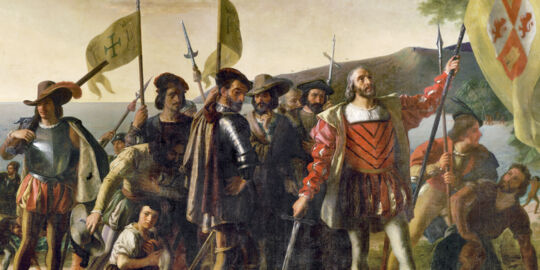
Christopher Columbus may have made first landfall in the New World in the Turks and Caicos on Grand Turk.
-
1512
Spanish explorer Ponce de Leon stopped in the islands, likely on Grand Turk, on his way to Bimini. If Columbus did not make first landfall in the Turks and Caicos, Ponce de Leon may have been the first European arrival. He named the island he landed on Isla del Viejo, which roughly translates to Islands of the Old Man, after the lone old Lucayan man he saw.
-
1515
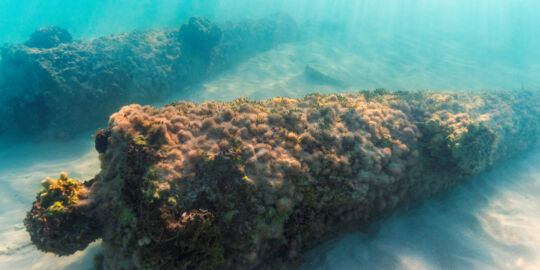
An unidentified Spanish caravel sailing ship wrecked on Molasses Reef near West Caicos in the Caicos Islands. This wreck became known as the Molasses Reef Shipwreck, and is the oldest excavated European shipwreck in the Americas.
-
1515-1530
The Lucayan populations rapidly decline, leading to the islands being essentially uninhabited. Radiocarbon dating of samples from Lucayan settlement sites assign ages no later than the very early 1600s, which is consistent with the complete disappearance of the Lucayans by the 1530s or 1540s.
-
1530-1720
The islands remain largely uninhabited. Pirates and buccaneers occasionally operate from the islands, perhaps as late as the mid 1700s, at which point the western side of the Caicos Islands was likely the epicenter of their presence. Pirates continue to occasionally make incursions into the islands until the early 1800s. The Turks and Caicos received a variant of its current name in the early 1500s, which roughly translates to ‘Pirate Islands’.
-
1563.
English explorer Captain John White visited West Caicos while on his way to the colony of Virginia. Some of his famous sketches from the period are very reminiscent of what he would have been likely to have seen on West Caicos, including an iguana, a flamingo, a land crab, and the Caribbean scorpion.
-
1660s
Bermudian ship ‘wreckers’ begin spending time in the islands salvaging shipwrecks and collecting salt from natural salt ponds. In the latter 1600s, the Bermudians have begun establishing settlements on Grand Turk and Salt Cay for the purpose of sea salt collection and export.
-
1750s
Bermudans have established permeant settlement, and begin development of the large scale sea salt salinas. Slaves and indentured servants are brought to the islands to work the salinas.
-
1753-1783
The French conduct various invasions and incursions, at various times holding Sand Cay, Grand Turk, Salt Cay, and ‘Grand Caicos’ ,which during the period likely referred to Providenciales, South Caicos, and all islands between them. Later, Grand Caicos was a term used for Middle Caicos. At one point, Bermudians present in the islands are evicted to Haiti. Horatio Nelson tries unsuccessfully to capture Grand Turk in 1873. Islands are officially restored to Britain by France under the 1783 the Treaty of Versailles.
-
1764
Britain officially claims ownership of the Turks and Caicos Islands. The islands are ruled as part of Jamaica.
-
1790s
After the American War of Independence, Loyalists were provided grants in the Caicos Islands by the British Crown to reimburse them for land lost in what became the United States. Loyalists built cotton plantations in the Caicos Islands, and brought African slaves.
-
1799
Britain decides to rule the Turks and Caicos through their territory of the Bahamas. This makes many of the Bermudian-origin residents unhappy.
-
1834
The British Empire enacted the Slavery Abolition Act, leading to the emancipation of slaves throughout the British Empire, which included the Turks and Caicos.
-
1841
The Spanish slave ship Trouvadore wrecked on the north coast of East Caicos. 192 slaves survive, many of which settled on Middle Caicos.
-
1852
The Grand Turk Lighthouse is assembled on Grand Turk. The sinking of the R.M.S Medina, which was the first British Royal Mail Service ship to be lost at sea, was the catalyst for the commissioning of the lighthouse.
-
1866
What is commonly known as the Great Nassau Hurricane struck the Turks and Caicos in September, and was perhaps the most destructive storm recorded in the islands. At least 50 people were killed, the salt and agricultural industries were devastated, and 1.4 million bushels of collected sea salt was lost.
-
1874
The Turks and Caicos Islands become a dependency of Jamaica, which was part of the British Empire at the time, as the islands were unable to maintain their own independent government.
-
1870-1920
In the Caicos Islands, attempts are made to expand beyond cotton planting. The sisal, guano mining, sponging, whaling, and seafood export industries were begun, and were met with limited success.
-
1898
The Turks and Caicos receives its first international telegraph connection, which connected Grand Turk to the rest of world via Bermuda.
-
Early 1900s
Grace Bay Beach received its name, after Grace Jane Hutchings, wife of Hugh Houston Hutchings, who was Commissioner of the Turks and Caicos at the time.
-
1950s
Due to the declines of the sea salt and sisal industries in the Turks and Caicos, many people in the Turks and Caicos emigrated to the Bahamas, primarily to Freeport.
-
1952-1954
The United States built two military bases on Grand Turk. NAVFAC 104 was a US Navy base on the north end of the island and conducted underwater sound monitoring of submarines and ships. South Base was a US Air Force base the primarily conducted missile tracking. Both sites were important during the Cuban Missile Crisis and the early days of the Space Race. The runway of South Base later became the Grand Turk JAGS McCartney International Airport (GDT).
-
1959
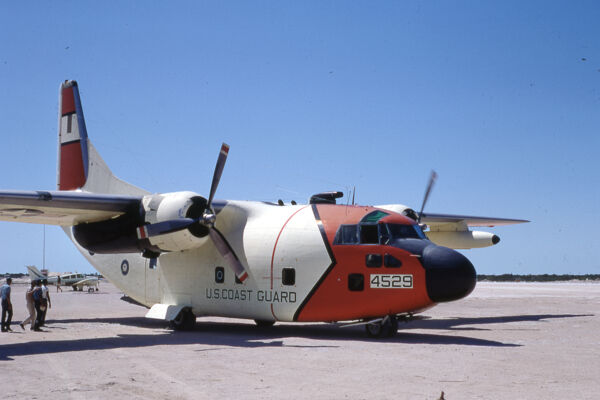
The United States builds a US Coast Guard station on South Caicos and an airport. This station was part of the LORAN-A radio navigation system. The site closed in 1980, as technology evolved and fewer stations were required. The airport became the South Caicos Airport (XSC).
-
1960
Hurricane Donna strikes the Turks and Caicos. The Caicos Islands are particularly devastated. Extensive flooding occurred on North Caicos, and the community of Whitby was flooded for months. The entirety of Half Moon Bay was washed out, and a full 3000 foot (900 m) channel was created between Little Water Cay and Water Cay.
-
1962
After Jamaican Independence from the UK in 1962, the Turks and Caicos decides to remain a British Crown Colony.
-
1962
John Glenn, the first American to orbit the earth, splashes down near Grand Turk in the Friendship 7 space capsule, and makes first landfall on the island. A month later Scott Carpenter landed near the country in the Aurora 7 capsule, and also made first landfall on Grand Turk.
-
1966
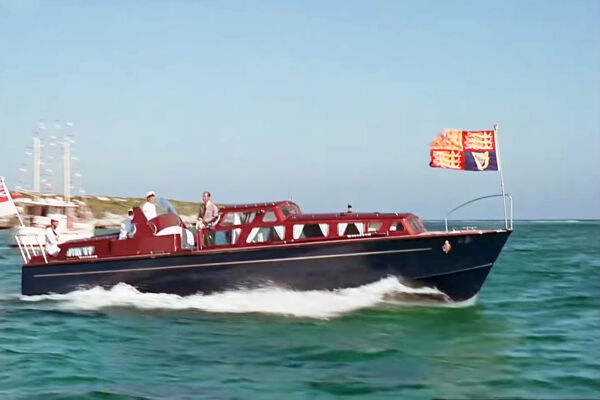
Queen Elizabeth II visited Grand Turk and South Caicos on the royal yacht HMS Royal Britannia.
-
1966
Provident Limited began operations in The Turks and Caicos, and the development of Providenciales as a tourism destination began.
-
1968
The first airport on Providenciales, Oxford Airstrip, opens. This was an international airport, and was located to the north of the current Providenciales International Airport (PLS) in the central Kew Town area.
-
1970
The Third Turtle Inn opened in Turtle Cove, and was the first hotel on Providenciales.
-
1975
The last shipment of salt is made from Salt Cay, and the industry comes to an end.
-
1976
The first parliamentary election was held under a party system. The Peoples Democratic Party (PDM) led by James Alexander George Smith (JAGS) McCartney wins a majority.
-
1980
JAGS McCartney, the Island’s first elected Chief Minister, was killed in a plane crash.
-
1983
The status of the Turks and Caicos changes from being a Crown Colony to a British Dependent Territory.
-
1984
Club Med Turkoise opens, which was the first Grace Bay Beach resort, the first all-inclusive, and the first of the large resorts.
-
1986-1988
Constitutional government in the Turks and Caicos was suspended by the United Kingdom following the arrest of the Chief Minister in the United States for drug trafficking charges and allegations of corruption and government involvement with drug trafficking. A commission of inquiry takes place.
-
1992
On December 18, 1992, American Airlines begins regular and weekly flights to the Turks and Caicos, paving the way for the island to become the tourism destination it is today.
-
2002
The United Kingdom changes the status of the Turks and Caicos Islands from British Dependent Territory to a British Overseas Territory. Islanders born in the country gained full British citizenship.
-
2006
The Grand Turk Cruise Center opens on Grand Turk, and the first cruise ships to the Turks and Caicos begin arriving.
-
2007
Hurricane Ike strikes the Turks and Caicos, and causes significant damage on Grand Turk, Salt Cay, and South Caicos. The just completed The North and Middle Caicos Causeway was heavily damaged.
-
2009
On 18 August 2009, the United Kingdom suspended the elected government of the Turks and Caicos over allegations of widespread and systemic corruption. The United Kingdom conducted direct rule of the Turks and Caicos until 2012.
-
2017
Within days of each other, Hurricane Irma and Hurricane Maria strike the Turks and Caicos, and cause extensive damage.
The Lucayans and Pre-Columbian Settlement
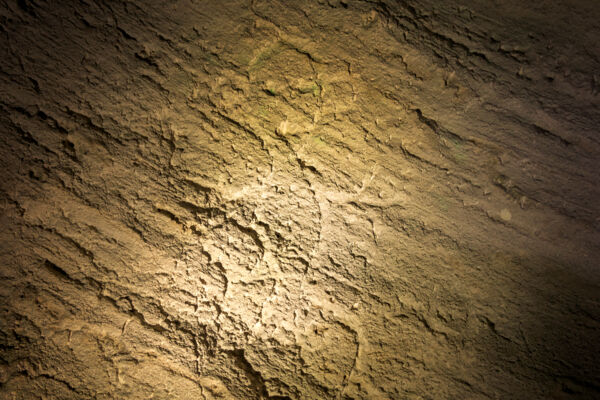
The first known inhabitants of the Turks and Caicos were the Lucayans, (also referred to as Tainos, or Lucayan Indians). It’s thought that these peoples migrated to the islands through the southern Caribbean from South America, as early as the year 700 AD.
Evidence suggests that initially, life was simple for the Tainos, yet by the 1400s, more complex agricultural practices were developed. Regular trade took place between what is now the Turks and Caicos and neighboring Hispaniola (the island that is home to Haiti and the Dominican Republic) and Puerto Rico. Salt and perhaps dried conch was likely traded for honey, fruit, tools, and possibly canoes.
Hunting and fishing were probably the main sources of food, yet limited planting of maize and manioc for food and cotton for textiles also helped to sustain daily life. New evidence is emerging from a Lucayan settlement site on Providenciales that may suggest that hutia and possibly iguanas were raised for food, as hutia bones recovered show a heavy dietary influence of maize!
There’s not enough evidence to be certain, yet it’s possible that several terrestrial animals were extant in the Turks and Caicos. These animals may have included a large iguana, land tortoises, the hutia, and a dwarf crocodile. If they had existed in the islands, the animals may have been hunted to extinction by the pre-Columbian peoples. The Turks and Caicos Islands rock iguana is the largest indigenous land animal still remaining.
Lucayan structures in the Turks and Caicos were primarily small to mid-sized huts, typically organized in small villages in favorable coastal locations. Evidence suggests that caves were used for shelter during storms and for ceremonial purposes.
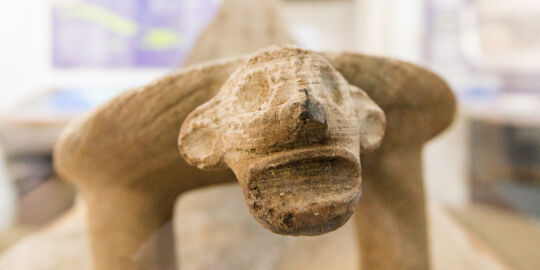
Small artifacts, mainly Palmetto Ware pottery shards and stone and shell tools, are the primary evidence of these aborigine peoples that still remains today. Some of the finest Lucayan artifacts that still exist from the islands include wood duho seats, of which less than ten were known to have been found, and the North Creek canoe paddle. The Turks and Caicos National Museum in Grand Turk houses the paddle and a duho, and perhaps the best collection of artifacts still preserved is held by the Smithsonian Institute in Washington DC.
The Lucayan populations were decimated after the arrival of Columbus due to a combination of Spanish slavery and disease. It’s thought that the last of the Lucayans in the Turks and Caicos disappeared by the early 1500s.
The Arawaks
A common term used when discussing the pre-Columbian peoples of the Turks and Caicos is Arawak. Arawak is a language family, and the Lucayans in the islands would have spoken a Classic Taino or Ciboney Taino dialect of the Arawak language. The pre-Columbian peoples of the Turks and Caicos and Bahamian islands are sometimes referred to as Arawaks, however, there are better-defined terms that can be used.
At the peak of its usage prior to the arrival of Columbus, variants and dialects of the Arawakan language spanned South America, Central America, and the Caribbean, and was spoken by millions of people.The Landfall of Christopher Columbus
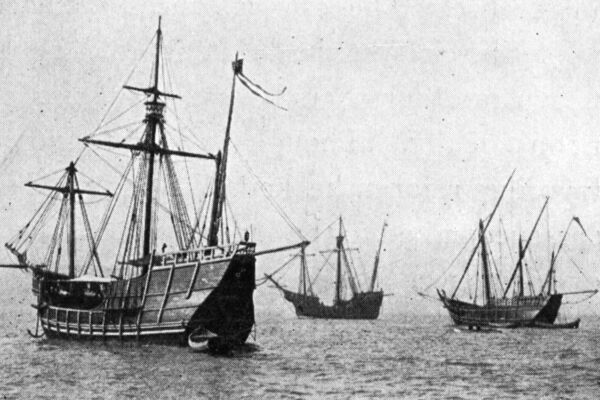
The point of first landfall of Columbus in the New World is a contentious issue. Many contemporary historians believe that it occurred somewhere in the Bahamas, yet the vague accounts from the historic voyage do match with Grand Turk and the Caicos Islands. In any case, if the Turks and Caicos wasn’t the first point of landfall, it was discovered by European explorers shortly after 1492.
Several famous Spanish, English, and Portuguese explorers did make stops in the Turks and Caicos, either on voyages of discovery, transits to Roanoke Island, or on slaving expeditions. Such visitors include Martin Alonso Pinzón and his brother Vincente Yáñez Pinzón who respectively commanded the vessels today known as the Pinta and the Nina from Columbus’ first trip, Juan Ponce De Leon, and English explorers Sir Richard Grenville and Captain John White.
One historical mystery in the Turks and Caicos is the Molasses Reef Wreck. This ancient European caravel shipwreck was found on Molasses Reef near West Caicos in the 1970s by treasure hunters. It was initially thought to be La Pinta from Columbus’, yet was later proven not to be. Artifacts from this amazing find can be seen at the National Museum. Further research carried out suggests a date circa 1513, and a vessel outfitted as an adventure and investment venture.
Salt Raking and the Bermudians
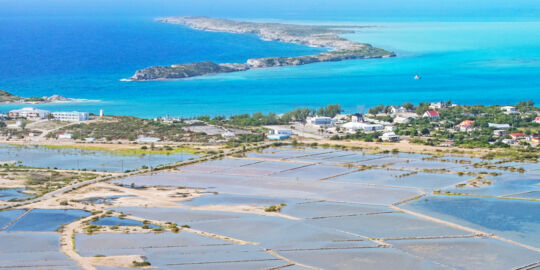
Barring the occasional visit to the Turks and Caicos by explorers on their way North America or South America, not much attention was paid to the islands until the late 1600s, when the low-lying marine wetlands on Salt Cay and Grand Turk began to be developed to facilitate efficient salt production. Colonialists from Bermuda were the first to see the potential of the shallow salt ponds in the Turks and Caicos. The trade started with seasonal visits to rake salt, yet progressed to a more serious year-round focus.
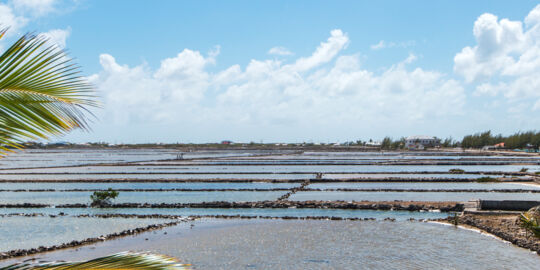
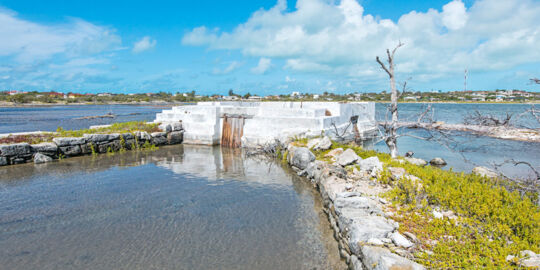
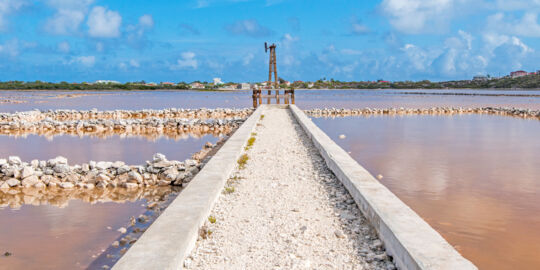
Initially, the infrastructure was simply to add ocean water into salinas, and block normal tidal inflow, yet eventually, the improvements led a complex system of ponds with progressive stages of brine to control consistent output, gates, and channels to control the water, and pumps to move brine between ponds.
Grand Turk, Salt Cay, and South Caicos all supported extensive and organized sea salt production, with South Caicos eventually being the major producer. By the start of the 20th century, exports reached 2 million bushels (about 140 million pounds, or 64 million kilograms), with around 800 acres (324 hectares) of developed salina, fractured by over 80 miles of (129 kilometers) stone salina walls.
West Caicos, Providenciales, East Caicos, and Middle Caicos all had experienced limited salt production at various times in history. A couple of salinas on Middle Caicos and Providenciales, at natural ponds such as Armstrong Pond, were likely worked by the Lucayans prior to the arrival of Columbus. Small ponds in the Caicos Islands produced salt that was gathered by visiting explorers and early settlers as well. From the early 16th century until the mid-20th century, salt exports were the backbone of the Turks and Caicos economy.
During the American Revolution, Turks Island salt was in high demand by the Americans for preserving meat. Legend says that George Washington himself specifically requested it from the Continental Congress due to its high quality. In 2020 US dollars, a pound of salt could fetch as high as $260.
European Struggles for Control
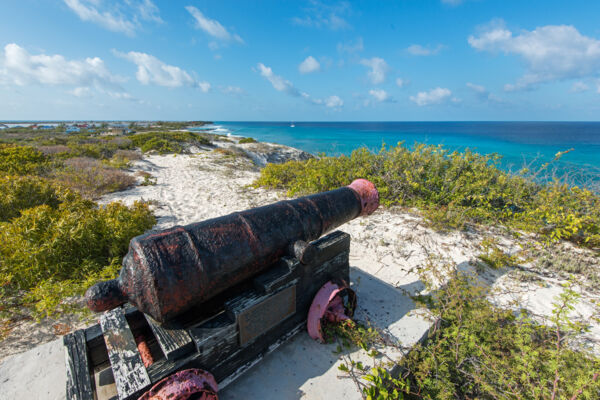
After the initial Spanish presence at Hispaniola, the Turks and Caicos was initially largely ignored by the European powers in the 16th century, as they pursued more lucrative regions. Eventually, the English, French, and Spanish all at various times claimed the Turks and Caicos Islands.
From the initial settlement of the salt-producing islands by the Bermudians and due to their control of the adjacent Bahamas, Great Britain maintained claim to the Turks and Caicos from the later 1600s, yet there were squabbles over which territory (Bermuda or the Bahamas) the Turks and Caicos fell under, which ultimately ended up in favor of the Bahamas.
Into the mid-1700s, the French tried to stake claims on the Turks and Caicos, with occasional incursions and intrusions until the 1783 Treaty of Versailles, which ratified with France the islands as part of the British Empire.
Pirates and Privateers
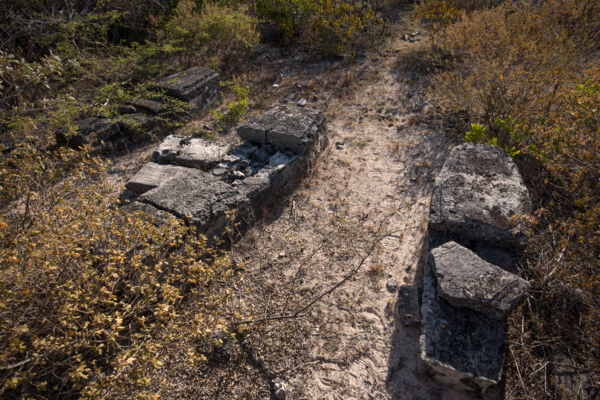
No history of the Turks and Caicos is complete without discussions of piracy, buccaneers, and privateers. In fact, the name Turks and Caicos essentially translates to ‘Pirate Islands’. Turkish corsairs and slavers were once a scourge on Europe, the Mediterranean, and northern Africa, and thus Turk was once used as a synonym for pirate. Early mapmakers combined Turks with a variant of the Lucayan word cayo hico (which meant archipelago, or islands), as a warning to avoid the ‘pirate islands’.
Several famous pirates are thought to have operated in the Turks and Caicos, including Françoise L’Olonnois (Jean-David Nau), Captain “Calico” Jack Rackham, Anne Bonny, and Mary Read. Parrot Cay may have served as a base for pirates, and it’s believed that the island used to be known as Pirate Cay, until its name was changed to be more socially acceptable.
The American Revolution, and the Loyalists
After the American War of Independence, displaced British Loyalists from the American Colonies were granted land on the uninhabited Caicos Islands. These settlers established plantations on several islands, including Providenciales, North Caicos, and Middle Caicos, to grow cotton. The cotton grown in the Turks and Caicos and Bahamian Archipelago by the Loyalists was referred to as Sea Island Cotton, and may have been derived from plants introduced to the islands from the Yucatan by the pre-Columbian Lucayans.
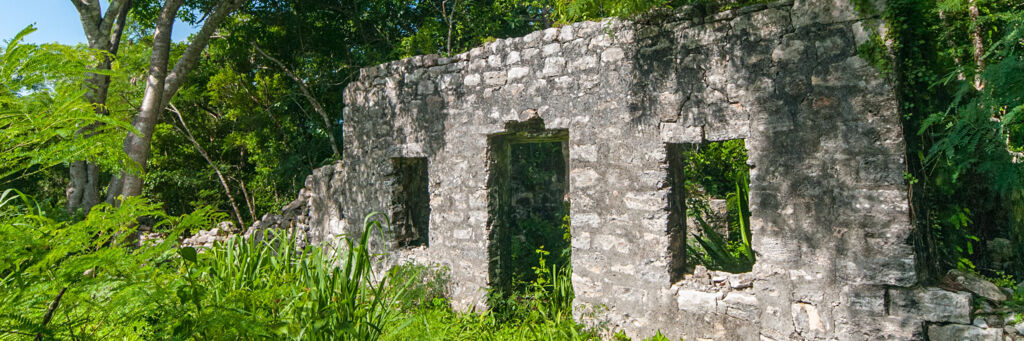
Initially, the attempts at growing cotton were quite successful, which led to the expansion of plantations such as Cheshire Hall, Wade's Green Plantation, Increase Plantation, and Haulover Plantation. The profitable times weren’t to last, as diseases, the boll weevil, and hurricane damage put an end to the cotton industry. The slaves brought by the Loyalists remained and were one of the ancestor groups of the people of the Turks and Caicos today.
Failures of the Cotton Plantations, and New Industries
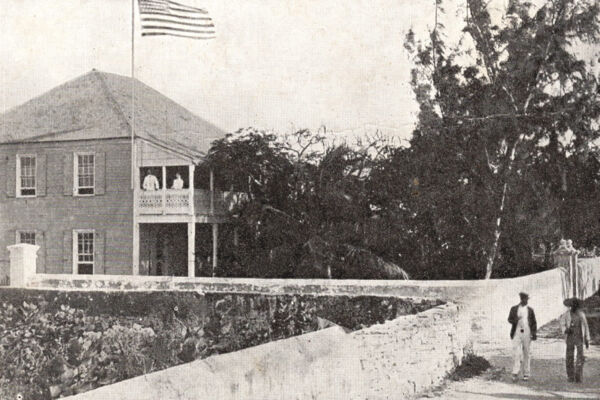
After the decline of the cotton planting, sea salt exports were still going strong. The Caicos Islands, however, needed new forms of income, which came in several unique ways.
Guano (bat excrement) mining and export, primarily for chemical and fertilizer uses, occurred on both Middle Caicos and East Caicos, which saw caves such as Conch Bar Cave and Indian Cave being completely emptied of all guano, soils, and Lucayan artifacts.
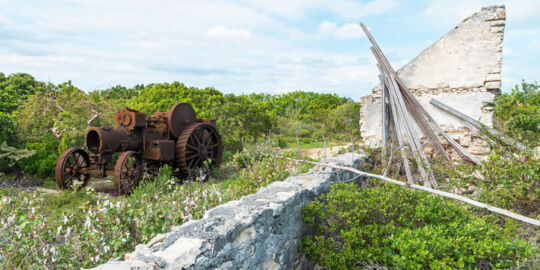
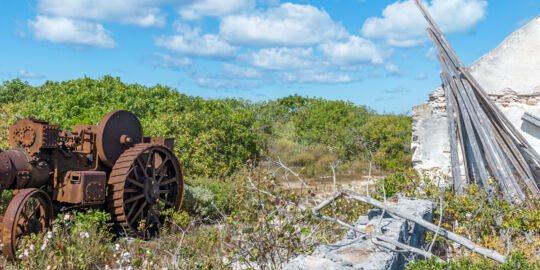
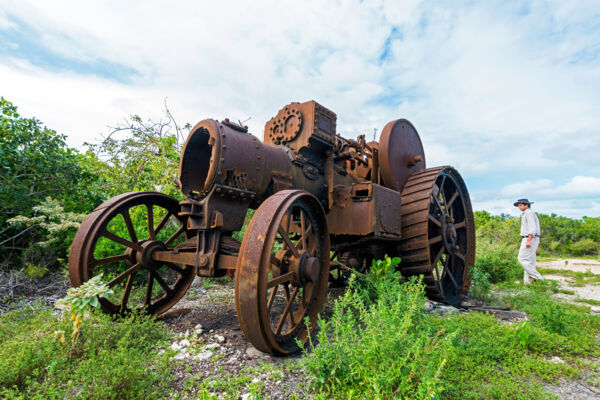
Sisal planting also took place on North Caicos, Middle Caicos, East Caicos, and West Caicos. East Caicos and West Caicos, after not being inhabited for centuries, saw small railroads and the settlements of Jacksonville and Yankee Town being built to facilitate the production of sisal. The Burrell Traction Engine, now the main sight at Yankee Town, was actually sent to the Turks and Caicos by mistake. It was intended to be shipped to sisal plantations in British West India, yet ended up at West Caicos in the British West Indies!
Sponging, which was the harvesting and cleaning of sea sponges for export, also took place, until over collection and disease depleted the natural stocks. Sea sponge farming was attempted in Chalk Sound on Providenciales and at Bell Sound on South Caicos. Sponge farming had limited returns, yet was carried on until the advent of synthetic sponges in the mid-1900s. During the decline of the sponge trade, the canning of lobster and turtle was also tried, with mixed results.
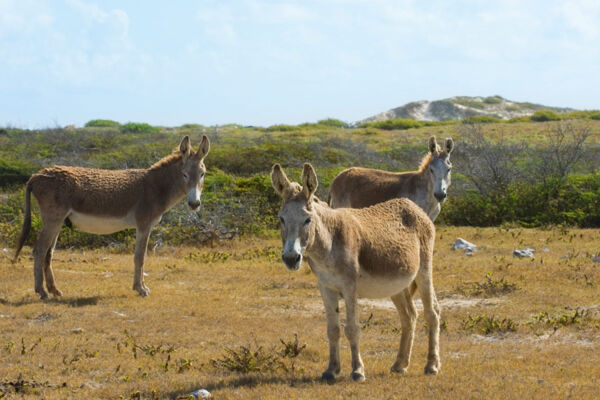
Wrecking, which was the salvaging of ships and cargoes that wrecked in the islands, also provided income to the impoverished Providenciales and Blue Hills and Wheeland settlement in the 19th century. The limited wrecking industry was also supplemented by the building of Caicos Sloops, which were small derivatives of English, French, and Portuguese vessels.
During the late Victorian Era, whaling of humpback whales for oil from Salt Cay also took place, as did cattle ranching on East Caicos and Hog Cay. Both attempts brought in some income, yet were never globally competitive.
In 1898, the London to Jamaica telegraph was completed, with Grand Turk in between. This led to the firm entrenchment of the communications industry by Cable & Wireless. It was only in 2006 that the final remnants of C&W’s (now renamed Flow) monopoly were finally untangled.
The World Wars
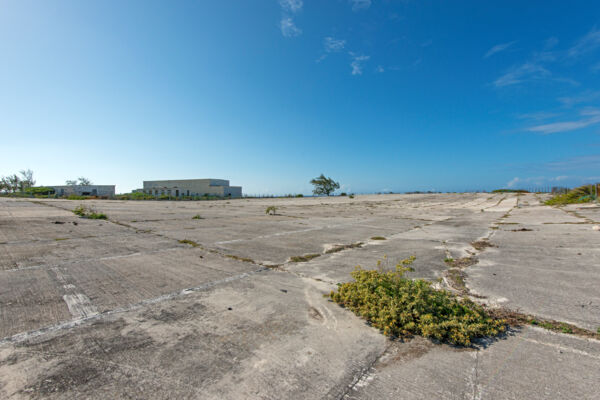
World War I dawned on an impoverished Turks and Caicos, still depending on what was a very limited salt raking industry to survive. Nevertheless, the islanders were able to raise money to fund an ambulance for World War I, which was used on the western front in Europe.
During World War II, the Turks and Caicos partially funded the Royal Navy frigate HMS Caicos, which was the only aircraft-detection frigate in use during the war. HMS Caicos was used in the North Sea to detect German V1 ‘doodlebug' flying bombs destined for London. The islands also managed to fund a Spitfire fighter, and weaved mittens and other articles for the soldiers.
The Turks and Caicos also managed to be involved in a German spy operation. Shortly before the war, a group of American investors approached the Islands' commissioner with plans to build a resort. The Islanders eagerly wined and dined the ‘investors’, and showed all the details of the islands. They left, never to be heard of again, until the maps and information were discovered in the possession of a German spy ring by the FBI. This information may have led to several ships being sunk by U-boats near the islands.
After the war, salt exports were still the primary income to the islands, which were struggling economically. It was even too costly to govern the islands as its own British Crown Colony, and the United Kingdom grouped them with, at first, the Bahamas, and then Jamaica. It wasn't until Jamaica became independent in 1962 that the islands became a Crown Colony in their own right. The Turks and Caicos received their first constitution in 1962.
The mid-1950s saw the construction of three United States bases: the U.S. Navy NAVFAC 104 and the Air Force South Base on Grand Turk, and the U.S. Coast Guard South Caicos LORAN Station. These projects brought jobs, economic income, and what become the Grand Turk JAGS McCartney International Airport (GDT) and the South Caicos Airport (XSC).
It was in 1962 that another historic event occurred in the Turks and Caicos, when American astronaut John Glenn first stepped back onto land on Grand Turk after the first space flight. Today, replicas of his spacecraft can be seen outside the Grand Turk Airport and the Grand Turk Cruise Center in Grand Turk.
)
The Latter 20th Century and the Dawn of the Tourism Industry
In 1967, Providenciales and the Turks and Caicos experienced a change of direction, with the arrival of Provident Limited at Blue Hills on Providenciales. This development company, headed by Fritz Ludington, negotiated a contract with the government for 4000 acres (1619 hectares) on Providenciales, on a conditional lease that included the construction of an airstrip, terminal, roads, and a hotel (the Third Turtle Inn at Turtle Cove). For the first time, Grace Bay and the other beautiful beaches on Providenciales were somewhat accessible to the international tourism market.
Providenciales remained a low-key destination until 1984 when Club Med Turkoise and a new airport opened. This sparked the continuing surge of development that has transformed Providenciales into one of the most popular tropical vacation destinations worldwide.
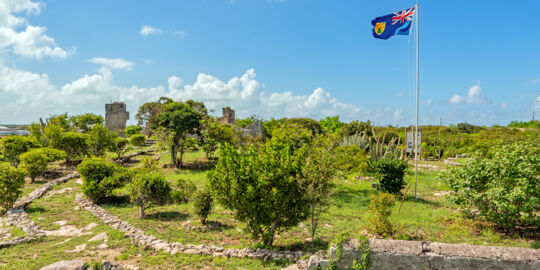
1968 was the year that the current Turks and Caicos flag was adopted, which is the British Blue Ensign and the Turks and Caicos Crest. The crest features a conch, Turk’s Head Cactus, and lobster.
In the 1970s, West Caicos, now appreciated for its environment, clear water, and reefs, had some environmental close calls. The first was in 1972 when multinational oil giant Exxon (Esso) attempted to put in an oil transshipment station and refinery, which saw an airstrip bulldozed and some equipment brought in before the deal fell through. Around the same time, aragonite mining and a nuclear waste dump site were also considered. Fortunately for the environment and the country, the proposals failed.
The Independence Movement and Self Governance
In the 1970s and 1980s, many former British Crown Colonies (as they were then known) were granted independence. This wave of nationalism raised calls for independence in the Turks and Caicos.
In 1980, the then-Government People’s Democratic Movement (PDM) party agreed with Britain that should they be re-elected that year, independence would be granted in 1982. Thus, the 1980 election effectively became a referendum on independence. The PDM lost (the Progressive National Party or PNP won) and independence was taken off the table.
Some talk of independence was raised in the mid-2000s, however, no party has made it a campaign issue since 1980. Likewise, over time, discussions were had on the Turks and Caicos joining Canada.